
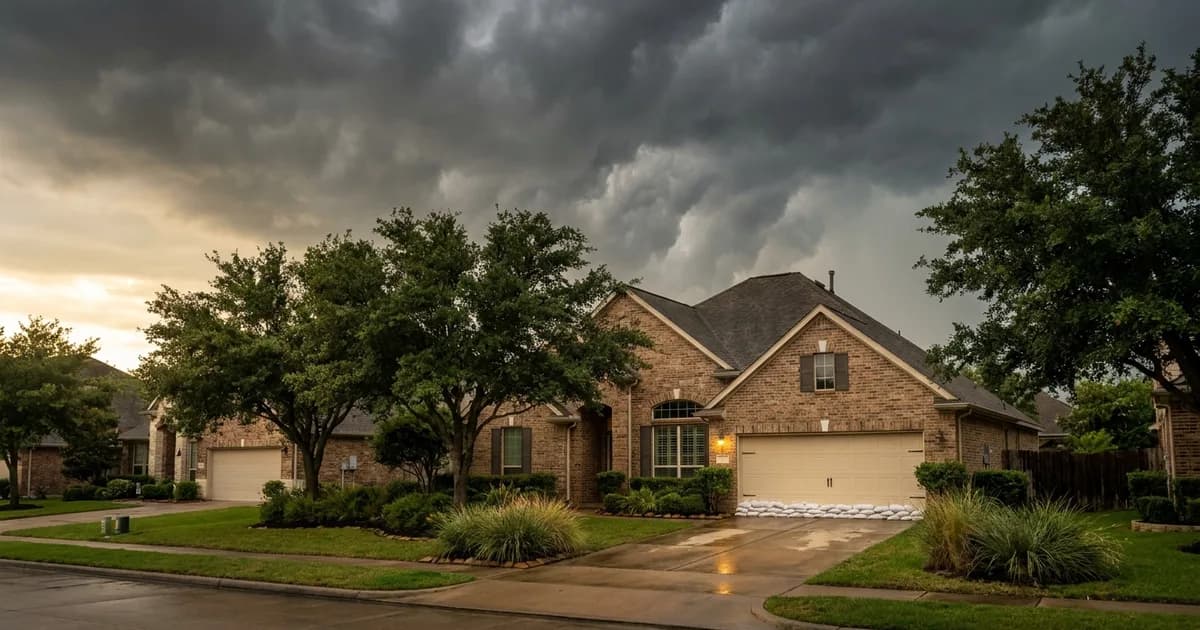
Protecting Your Houston Rental During Hurricane Season: A 2026 Landlord Checklist
Hurricane season prep for Houston landlords: flood risk, insurance gaps, Texas repair duties, and a pre-storm checklist to protect your rental in 2026.
 Flat Fee Landlord TeamJuly 17, 202612 min read
Contents▾
- The 2026 Atlantic hurricane season outlook
- Why Houston and Harris County carry outsized flood risk
- The pre-season prep checklist (do this before June)
- Insurance: the gap that sinks Houston landlords
- Your legal duties after a storm: Texas Property Code Chapter 92
- Security deposit vs. casualty damage
- Lease provisions every Houston landlord should carry
- Tenant communication and evacuation info
- What to do immediately after a storm
- Houston hurricane-season landlord checklist
- Frequently asked questions
- Sources & last reviewed
Hurricane season prep for Houston landlords: flood risk, insurance gaps, Texas repair duties, and a pre-storm checklist to protect your rental in 2026.
Free Instant Rent Estimate
What could your property rent for?
Enter your property address and see an instant comps-based rent estimate — right here, no waiting.
Houston sits on the Gulf Coast, so every rental here needs a hurricane plan before a storm is named — not after. The three moves that protect your asset most: confirm you carry flood insurance separate from your landlord policy, because standard policies do not cover flood and the federal flood program has a 30-day waiting period; harden the home before June (roof, drainage, trees, board-up plan, documentation photos); and know your repair duties under Texas Property Code Chapter 92 so a post-storm response is fast and lawful.
Fast checklist:
- Buy or renew flood insurance now — do not wait for a storm in the Gulf.
- Photograph every room, the roof, and the exterior before the season.
- Clear gutters, drains, and the yard; trim trees away from the roof.
- Confirm your lease requires renters insurance and has a casualty clause.
- Look up the property's evacuation ZIP zone on ReadyHarris.org.
- Keep a written after-storm response plan and vendor contacts on hand.
Hurricane season on the Texas Gulf Coast runs June 1 through November 30. If you own a rental in Greater Houston or anywhere in Harris County, the season is not an abstract risk — it is the single largest threat to your property and your tenants each year. This guide is built for local owners: what the 2026 outlook says, where Houston's flood and surge risk comes from, how to prepare the home, what insurance actually covers, and your legal duties once the wind stops.
The 2026 Atlantic hurricane season outlook
NOAA is forecasting a below-normal 2026 Atlantic hurricane season — a 55% chance of below-normal activity, 35% near-normal, and 10% above-normal. The agency expects 8 to 14 named storms, of which 3 to 6 could become hurricanes and 1 to 3 could become major hurricanes (Category 3 or higher). (NOAA)
Here is the part every landlord should internalize: a "below-normal" season is not a safe season. NOAA states plainly that its outlook is not a landfall forecast — it says nothing about where or when a storm will hit land. Hurricane Harvey formed in a season that was not forecast to be extreme, and it became the largest rainfall event ever recorded in the continental United States. One storm on the wrong track is all it takes. Preparedness is not about the season's total count. It is about your one property.
Why Houston and Harris County carry outsized flood risk
Houston's risk is not just wind — it is water. The region is flat, heavily paved, and drained by bayous that fill fast. That combination turns tropical rainfall into widespread flooding well inland from the coast.
The numbers from Hurricane Harvey in 2017 make the point:
- Harvey damaged roughly 204,000 homes in Harris County, and about three-fourths of them sat outside the 100-year floodplain — meaning most of those owners had no flood insurance. (HCFCD)
- An estimated 70% of Harris County was covered by at least 1.5 feet of water. (HCFCD)
- Roughly one trillion gallons of water fell on the county in four days, with a peak of 48.2 inches of rain near Houston. (NOAA Climate.gov)
The lesson landlords keep relearning: your property does not need to be in a mapped flood zone to flood. FEMA is finalizing a new Harris County flood map for the first time in nearly two decades, and it is expected to expand the areas shown at risk. Check your property against the Harris County Flood Education Mapping Tool and the Flood Warning System, and assume rainfall flooding is possible regardless of what an older map shows. (Harris County FEMT; Harris County FWS)
The pre-season prep checklist (do this before June)
Foundational hardening is cheaper than a claim and faster than a scramble. Walk the property — or send a manager — and work through each system.
Roof
Inspect for loose, cracked, or missing shingles and lifted flashing. A roof that is already compromised is the first thing a hurricane exploits. Address repairs before the season, not after.
Windows and board-up plan
Decide now how you will protect glass: impact-rated windows, storm shutters, or pre-cut plywood panels labeled per opening and stored on site. Buying plywood the day before landfall is not a plan.
Drainage and gutters
Clear gutters and downspouts, and make sure water is directed away from the foundation. Clogged drainage is one of the most common causes of avoidable water intrusion.
Trees and yard
Trim limbs that overhang the roof and remove dead branches. Secure or store anything in the yard that becomes a projectile in high wind — furniture, grills, planters, signage.
Sump pump and backflow
If the property has a sump pump, test it and consider a battery backup. A sewer backflow valve helps prevent the second, ugly flood — sewage pushing back into the home during a surge.
Documentation
Photograph and date every room, the roof, the exterior, and major systems before the season. This is your baseline. After a storm, "before and after" photos are the difference between a smooth insurance claim and a disputed one.
Insurance: the gap that sinks Houston landlords
This is the section that costs owners the most when they get it wrong. Read it twice.
Standard landlord and dwelling policies do not cover flood. The Texas Department of Insurance is explicit: most home policies do not cover damage caused by floods, and flood damage is almost universally excluded from standard homeowners and windstorm coverage. (TDI)
Wind and flood are two different perils. In most of inland Harris County, your dwelling policy covers wind and hail. But windstorm policies exclude damage from rising water, including storm surge. So a hurricane can hit you two ways — wind from above, water from below — and only one of them is covered by a standard policy. (TDI)
Flood insurance is separate — usually through the NFIP. The National Flood Insurance Program, run by FEMA, is how most owners cover flood. If your property is in a designated flood zone and carries a mortgage, your lender requires it. Even if it does not, Harvey proved that "not in a flood zone" is not the same as "will not flood." (FEMA)
The 30-day waiting period is the trap. A new NFIP flood policy typically does not take effect for 30 days. You cannot buy it when a storm enters the Gulf and expect it to help — by then it is too late. Put your policy in force well before the season, and renew before it lapses. (FEMA; TDI)
If you take one action from this article, make it this: confirm today that you carry flood coverage on every Houston rental, and that it is active — not pending, not lapsed.
Your legal duties after a storm: Texas Property Code Chapter 92
When a storm damages a tenant-occupied rental, Texas law sets the rules. Knowing them in advance keeps your response fast and defensible.
The repair duty (Section 92.052). A landlord must make a diligent effort to repair conditions that materially affect the physical health or safety of an ordinary tenant. Storm damage that lets water, mold, or the elements into the home falls squarely in this category.
Insured-loss timing (Section 92.054). When damage comes from an insured casualty — including storm and hail — the clock for making repairs does not start until you receive the insurance proceeds. This is one more reason to carry the right coverage and file promptly: your repair timeline is tied to your claim. (Texas Property Code Section 92.054)
Total loss — either party may end the lease. If a casualty leaves the home, as a practical matter, totally unusable for residential purposes — and the tenant did not cause it — either the landlord or the tenant may terminate the lease with written notice before repairs are finished. If terminated, the tenant gets a pro-rata refund of rent from the move-out date plus any refundable deposit. (FindLaw - Tex. Prop. Code Section 92.054)
Partial loss — rent reduction. If the home is only partially unusable and the tenant is not at fault, the tenant may be entitled to a proportionate rent reduction — but only on judgment of a county or district court. (Texas Property Code Section 92.054)
A landlord and tenant can agree to different casualty terms in a written lease, which is exactly why your lease language matters.
Security deposit vs. casualty damage
Do not confuse the two. A security deposit covers damage a tenant causes beyond normal wear and tear. Storm damage is not tenant damage. You cannot charge a tenant's deposit for a roof the wind tore off or water a hurricane drove into the home. Casualty losses run through your insurance and your repair duty — not the deposit. Treating a hurricane as a deposit deduction is both wrong and a fast way to a dispute you will lose.
Lease provisions every Houston landlord should carry
Your lease is a preparedness tool. Before the season, confirm it includes:
- A renters insurance requirement so tenants can cover their own belongings, which your policies do not.
- A casualty and lease-termination clause that spells out what happens if the home is damaged or destroyed, consistent with Chapter 92.
- A tenant-responsibility clause for basic storm readiness — bringing in loose items, reporting damage promptly, and not blocking access for repairs.
- A communication and access clause allowing entry for emergency inspection and repair after a storm.
Tenant communication and evacuation info
Your tenants are the people inside the asset. Give them the information that keeps them safe and keeps damage from compounding.
- Share the property's evacuation ZIP zone. ReadyHarris.org publishes a Hurricane Evacuation ZIP Zone Map and routes by ZIP code — send it to every tenant before the season. (ReadyHarris)
- Provide a single point of contact for reporting damage, and set expectations on response time.
- Encourage tenants to sign up for Ready Harris Alerts from the county's Office of Homeland Security and Emergency Management.
- Remind tenants to document their own belongings and carry renters insurance.
What to do immediately after a storm
- Confirm tenant safety first. People before property, always.
- Document everything before touching it — photos and video of all damage, dated, room by room and outside.
- Stop the bleeding. Make reasonable temporary repairs to prevent further damage (tarp a roof, cover broken windows). Keep receipts.
- File your insurance claim promptly — dwelling and flood, as applicable, each on its own claim deadline. Your repair clock on an insured loss starts when proceeds arrive.
- Begin diligent repairs of health-and-safety conditions per your Chapter 92 duty.
- Communicate the timeline to your tenant in writing, and address habitability quickly.
Houston hurricane-season landlord checklist
Before the season (by June 1)
- Flood insurance active on every property (remember the 30-day waiting period).
- Landlord/dwelling policy reviewed for wind and hail coverage and deductible.
- Roof inspected and repaired.
- Gutters, downspouts, and yard drains cleared.
- Trees trimmed back from the roof; dead limbs removed.
- Board-up materials or shutters ready and labeled.
- Sump pump tested; backflow valve confirmed.
- Full photo/video documentation of the property, dated.
- Lease confirmed: renters insurance requirement plus casualty clause.
- Property's ReadyHarris evacuation ZIP zone identified and shared.
When a storm is forecast
- Notify tenants; send evacuation zone and routes.
- Secure or store loose exterior items.
- Install shutters/board-up; confirm tenant has a plan.
- Verify insurance policies are current and accessible.
After the storm
- Confirm tenant safety.
- Document all damage before cleanup.
- Make temporary repairs to prevent further loss.
- File insurance claims promptly.
- Begin diligent repairs; communicate timeline in writing.
For more local context, read the 2026 local owner's guide to Houston property management, or see how much property management costs in Houston.
Hurricane season rewards owners who prepare early and punishes those who scramble. If you would rather have a local team handling the inspections, the documentation, the tenant communication, and the fast, lawful storm response, that is exactly what we do. Learn more on our Houston property management hub, or get a quote for Houston property management.
Frequently asked questions
Does landlord insurance cover flood damage in Houston?
No. Standard landlord and homeowners policies exclude flood, and windstorm coverage excludes rising water and storm surge. Flood is a separate policy, usually through FEMA's National Flood Insurance Program. In Houston's flood-prone terrain, carrying it is essential even outside a mapped flood zone. (TDI; FEMA)
Who is responsible for repairs after a hurricane in a Texas rental?
The landlord. Under Texas Property Code Section 92.052, the landlord must make a diligent effort to repair conditions that materially affect a tenant's health or safety. When the loss is insured, Section 92.054 says the repair period starts when the landlord receives insurance proceeds. (Texas Property Code Section 92.054)
Can a tenant break a lease if the home is damaged in a storm?
Yes, if the home is, as a practical matter, totally unusable for residential purposes and the tenant did not cause the damage. Under Section 92.054, either party may terminate with written notice before repairs are complete, and the tenant is owed a pro-rata rent refund and any refundable deposit. (FindLaw - Tex. Prop. Code Section 92.054)
Can I use the security deposit to pay for hurricane repairs?
No. A security deposit covers tenant-caused damage beyond normal wear and tear. Storm damage is a casualty loss handled through insurance and your repair duty, not the deposit. Charging a deposit for storm damage invites a dispute you are likely to lose.
When should I buy flood insurance for my Houston rental?
Well before hurricane season. A new NFIP flood policy typically has a 30-day waiting period before it takes effect, so buying it once a storm is in the Gulf will not help for that storm. (FEMA)
How do I find my rental's hurricane evacuation zone?
Use ReadyHarris.org, which publishes Harris County's Hurricane Evacuation ZIP Zone Map and routes by ZIP code. Look up each property and share the zone with your tenants before the season. (ReadyHarris)
Sources & last reviewed
- NOAA — 2026 Atlantic hurricane season outlook
- Harris County Flood Control District — Hurricane Harvey
- Harris County Flood Control District — Countywide Impacts
- NOAA Climate.gov — Reviewing Hurricane Harvey's rain and flooding
- Harris County Flood Education Mapping Tool
- Harris County Flood Warning System
- FEMA — Flood Insurance
- Texas Department of Insurance — Flood insurance
- Texas Department of Insurance — What is windstorm insurance?
- Texas Property Code Chapter 92
- FindLaw — Texas Property Code Section 92.054 Casualty Loss
- ReadyHarris — Harris County emergency preparedness
Last reviewed July 17, 2026 by the Flat Fee Landlord Houston team.
2,000+
Tenants Placed
<1%
Eviction Rate
9–12 Mo
Tenant Guarantee
4.6★
Google Rating
Our Services

Flat Fee Landlord Team
Flat Fee Landlord
The Flat Fee Landlord team helps landlords across Texas and the DMV find great tenants, stay legally protected, and maximize rental income — for one flat monthly fee.
Frequently Asked Questions
Does landlord insurance cover flood damage in Houston?▾
No. Standard landlord and homeowners policies exclude flood, and windstorm coverage excludes rising water and storm surge. Flood is a separate policy, usually through FEMA's National Flood Insurance Program. In Houston's flood-prone terrain, carrying it is essential even outside a mapped flood zone.
Who is responsible for repairs after a hurricane in a Texas rental?▾
The landlord. Under Texas Property Code Section 92.052, the landlord must make a diligent effort to repair conditions that materially affect a tenant's health or safety. When the loss is insured, Section 92.054 says the repair period starts when the landlord receives insurance proceeds.
Can a tenant break a lease if the home is damaged in a storm?▾
Yes, if the home is, as a practical matter, totally unusable for residential purposes and the tenant did not cause the damage. Under Section 92.054, either party may terminate with written notice before repairs are complete, and the tenant is owed a pro-rata rent refund and any refundable deposit.
Can I use the security deposit to pay for hurricane repairs?▾
No. A security deposit covers tenant-caused damage beyond normal wear and tear. Storm damage is a casualty loss handled through insurance and your repair duty, not the deposit. Charging a deposit for storm damage invites a dispute you are likely to lose.
When should I buy flood insurance for my Houston rental?▾
Well before hurricane season. A new NFIP flood policy typically has a 30-day waiting period before it takes effect, so buying it once a storm is in the Gulf will not help for that storm.
How do I find my rental's hurricane evacuation zone?▾
Use ReadyHarris.org, which publishes Harris County's Hurricane Evacuation ZIP Zone Map and routes by ZIP code. Look up each property and share the zone with your tenants before the season.
You might also like
- Houston Property Management in 2026: A Local Owner's Guide to Hiring the Right ManagerApril 30, 2026Hiring a Houston property manager in 2026? Compare costs, services, and red flags across Cypress, Ka…
- How Much Does Property Management Cost in Houston, TX? A 2026 Fee GuideApril 14, 20268–10% fees cost Houston landlords $168–$280/month. Flat fee: $139, fixed. Full 2026 breakdown of pla…
Free Instant Rent Estimate
What could your property rent for?
Enter your address — see an instant comps-based rent estimate.
- ⭐ 4.6 stars · 740+ Google reviews
- ✅ 2,000+ tenants placed
- ✅ <1% eviction rate
- ✅ Tenant assurance on eligible bundles