
Should I Rent or Sell My Austin Home? A 2026 Decision Guide
Torn between renting out your Austin home or selling in 2026? Real comps, real math, and the 6 questions every accidental landlord needs to answer first.
 Mo HashemApril 23, 202619 min read
Contents▾
- The Austin Housing Market in 2026: What You're Actually Facing
- Rent or Sell: The 6 Questions That Actually Settle It
- Austin Rental Market Snapshot: Submarket Rent Ranges
- The Real Math: Rent vs. Sell on a $550,000 Austin Home
- The Hidden Costs Most First-Time Austin Landlords Miss
- City of Austin Rental Registration: Don't Skip This
- Finding a Tenant Who Won't Trash Your Austin Home
- Self-Manage vs. Flat-Fee vs. 8% Property Management in Austin
- When Renting Is the Wrong Call
- What to Do Next Week
Torn between renting out your Austin home or selling in 2026? Real comps, real math, and the 6 questions every accidental landlord needs to answer first.
Free Instant Rent Estimate
What could your property rent for?
Enter your property address and see an instant comps-based rent estimate — right here, no waiting.
You bought your Austin home during the boom. Maybe it was Mueller in 2021. Maybe East Austin in 2022. Maybe Round Rock or Cedar Park when the tech layoffs reshuffled your plans. Now you're relocating, downsizing, divorcing, or just ready for something new — and the listings near you are sitting 60, 90, 120 days on market with price cuts. Selling feels like leaving money on the table. Renting feels like a second job you didn't sign up for.
You are not alone. Zillow Research reports that 4.1% of Austin rental listings had previously been listed for sale (data through October 2025), second only to Houston among the four Texas metros and well above the 2.3% national share. The reason is simple: in a market where sellers are competing with sellers, renting it out locks in monthly cash flow, preserves a long-term appreciation bet on Austin, and buys you time to sell into a stronger market later. Put your own numbers into our rent vs sell calculator to see which path leaves you ahead.
But "rent it out" is not a single decision. It's six decisions stacked on top of each other — and the difference between a smart accidental landlord and a stressed one comes down to knowing which questions to ask before you hand someone the keys. This guide walks you through the exact framework we use with Austin homeowners every week — real rent comps by submarket, a 6-question decision test, a side-by-side 5-year projection on a $550K Austin home, the hidden costs that sink first-time landlords, and what Texas and City of Austin rules actually require.
The short version: Rent if your mortgage rate is under 5%, you have 3+ years before you need the equity, and your property would break even or better after realistic reserves. On a typical $550K Austin home, renting for 5 years then selling beats selling now by roughly $76,800 in net equity. Sell if you need the capital within 12 months, you're inside the IRS Section 121 2-of-5 year window with significant gains, your margins are structurally negative, or the property has deferred capex you can't fund.
The 2026 Austin market rewards homeowners who run the real math before listing.
The Austin Housing Market in 2026: What You're Actually Facing
Austin has shifted. After five years of "list on Friday, under contract by Monday," the 2026 market tells a different story. Inventory is up, days-on-market has stretched, and sellers who anchored on 2022 peak prices have watched buyers walk. The numbers Austin homeowners need to know going into this decision:
- More listings, fewer buyers. Active listings across the Austin metro have climbed significantly compared to 2022–2023. Months of supply has shifted from a seller's market toward neutral or buyer-leaning in several submarkets.
- Price softness in core ZIPs. Neighborhoods like 78702 (East Austin), 78704 (South Austin), and 78759 (Northwest Austin) have seen meaningful price cuts on a large share of listings. Suburbs like Cedar Park, Leander, and Pflugerville have held up better.
- Rents have stayed resilient. While sale prices have cooled, single-family rents have held firm — especially in family-friendly submarkets with strong schools like Cedar Park, Round Rock, and Westlake. Corporate relocations and tech hiring cycles continue to create renter demand.
- Interest rates still matter. If you bought at a 3–4% rate, your mortgage is a strategic asset. Selling means that rate goes away forever. Renting means you keep it working, and most owner-occupant loans let you rent once their occupancy terms are met.
The bottom line: if you can afford to wait to sell, renting preserves optionality. You capture rent today, you keep your appreciation bet on Austin, and you keep your low mortgage rate locked in. If you can't afford to wait — if you need the equity now — selling is the right call. This guide helps you figure out which camp you're in.
Rent or Sell: The 6 Questions That Actually Settle It
Most "rent or sell" calculators skip the personal reality and jump straight to the spreadsheet. Don't do that. These six questions — in this order — decide the answer.
1. Do you have a deadline to take the equity out?
If you're using the proceeds to buy your next home, pay for a divorce settlement, or fund a major life event within 12 months, sell. Renting locks your equity in place for at least 3–5 years to be worth the setup cost. If the timeline is loose — "eventually" or "in the next 5 years" — renting is on the table.
2. What's your current mortgage rate and monthly payment?
Pull up your mortgage statement and write down your current interest rate, your monthly PITI (principal + interest + taxes + insurance + HOA), and your remaining principal balance. If your rate is under 5%, your mortgage is an asset. Selling gives it up for a new mortgage at 6.5–7.5% (current rates). That differential is worth real money. If your rate is 6.5%+ and the property just barely covers carrying costs, the case for renting weakens.
3. What's the 2-of-5 capital gains clock on your property?
Under IRS Section 121, if you lived in the home as your primary residence for 2 of the last 5 years, you can exclude up to $250,000 in capital gains (single) or $500,000 (married filing jointly) when you sell. This is big. If you're nearing the end of that 5-year window and you've built meaningful equity, selling before the clock runs out can save you tens of thousands in capital gains tax. Renting eats into that window — each year you rent, one of the "5 years" falls off the back end.
(Not tax advice — talk to your CPA before making this decision. But do the math.)
4. How much equity do you actually have?
Austin homeowners who bought in 2020–2021 at the trough and held through the peak often have $150K–$400K+ in equity. That equity is a decision input.
- High equity + low rate: rent it. You keep the rate, you earn rent, and the equity compounds quietly.
- Low equity + high rate: sell if you can cover closing costs. Renting a thin-margin property is a recipe for stress.
5. How emotionally attached are you to this house?
This matters more than most financial advisors will admit. If you raised kids in this house, if you installed the kitchen yourself, if you can't imagine strangers living there — renting is going to feel worse than you expect. If it's a house you bought, lived in, and are genuinely ready to move on from — renting is easy.
6. Do you have the bandwidth to manage a rental?
Landlording is a real job. Even with excellent tenants, a self-managed rental takes 5–10 hours a month on average. Bad month (burst pipe at midnight, eviction, major turn): 30+ hours. If you're moving out of state, mid-career at a demanding job, or raising young kids — hire a property manager. The 10% you'll save trying to self-manage is the single most expensive 10% you'll save in your life.
Scoring your answers: 4+ answers pointing to "rent" means you're a strong rent-out candidate. 4+ answers pointing to "sell" means sell it and move on. Mixed — run the real math below.
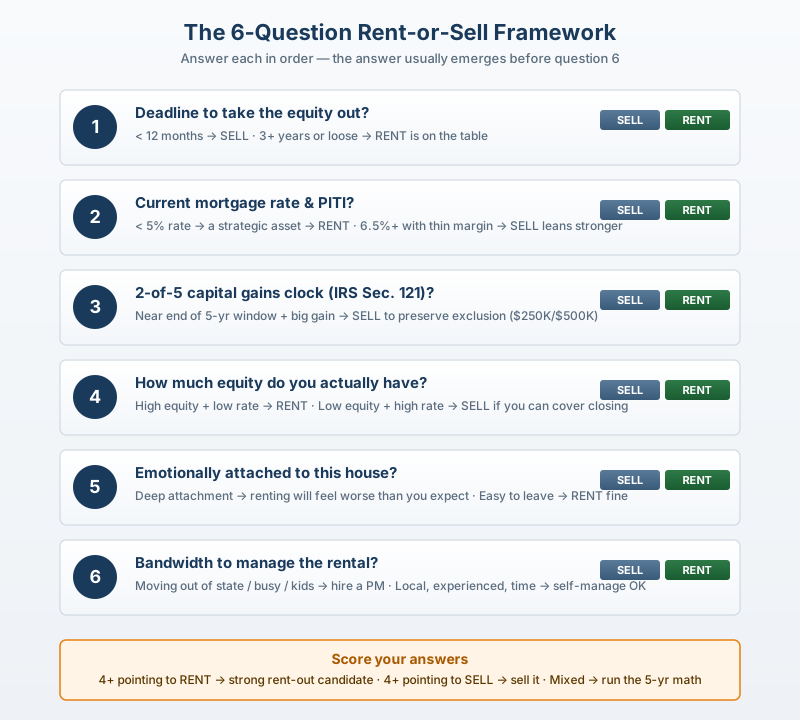
Score the 6 questions before opening a spreadsheet.
Austin Rental Market Snapshot: Submarket Rent Ranges
Before you decide, you need a real number on what your home would actually rent for. Generic city-wide averages will mislead you — Austin's submarkets have very different profiles.
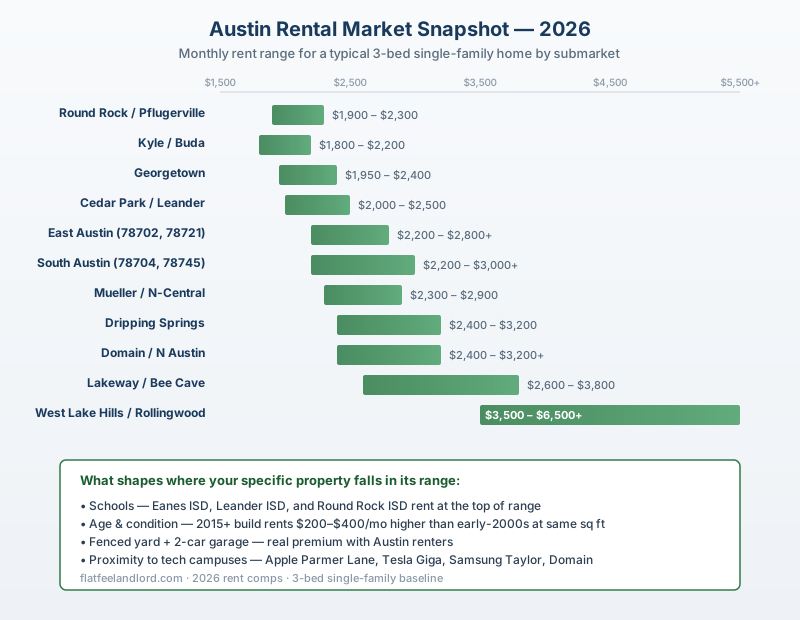
Realistic 2026 rent ranges for a typical 3-bed single-family Austin home by submarket.
Realistic 2026 monthly rent ranges for a typical 3-bedroom single-family home, against an Austin metro single-family average of $2,312 a month in August 2026:
- Round Rock / Pflugerville: $1,900–$2,300
- Cedar Park / Leander: $2,000–$2,500
- Georgetown: $1,950–$2,400
- Kyle / Buda: $1,800–$2,200
- South Austin (78704, 78745, Oak Hill): $2,200–$3,000+
- East Austin (78702, 78721): $2,200–$2,800+
- Mueller / North-Central (78722, 78723): $2,300–$2,900
- Domain / North Austin (78758, 78759): $2,400–$3,200+
- West Lake Hills / Rollingwood: $3,500–$6,500+
- Lakeway / Bee Cave: $2,600–$3,800
- Dripping Springs: $2,400–$3,200
A few things shape where your specific property falls in its range:
- Schools. Homes zoned to Eanes ISD, Leander ISD, or Round Rock ISD rent at the top of their range. Austin ISD homes vary more by specific elementary zone.
- Age and condition. A 2015+ build with modern finishes rents $200–$400/month higher than an early-2000s build at the same square footage.
- Yard and garage. Austin renters will pay a real premium for a fenced yard and a 2-car garage.
- Proximity to tech campuses. Homes within a 25-minute drive of Apple's Parmer Lane campus, Tesla's Gigafactory, Samsung's Taylor fab, or the Domain consistently rent faster and for more.
Get your exact number. General ranges help you plan — but before you decide, you want the real comp for your specific address. Our free rental analysis pulls 2026 comps within a 1-mile radius and matches them to your square footage, bed/bath count, year built, and condition. Get your free Austin rental analysis →
The Real Math: Rent vs. Sell on a $550,000 Austin Home
Let's run actual numbers on a realistic Austin scenario. A 2018-built 3-bed, 2.5-bath, 2,100 sq ft home in Cedar Park. Current market value: $550,000. Original purchase (2020): $425,000. Current mortgage: $340,000 balance at 3.5%. Monthly PITI: $2,450 (including $8,400/yr property taxes and $2,100/yr insurance). Realistic 2026 rent: $2,500/mo.
Scenario A: Sell in 2026
- Sale price: $550,000
- Selling costs (6% agent + 1.5% other closing): -$41,250
- Mortgage payoff: -$340,000
- Net proceeds: $168,750
- Capital gains (assuming 2-of-5 Section 121 exclusion applies, married filing jointly): $0 tax owed
- Take-home: $168,750 today
Scenario B: Rent for 5 years, then sell
| Item | Year 1 | Year 2 | Year 3 | Year 4 | Year 5 |
|---|---|---|---|---|---|
| Gross rent ($2,500/mo × 12, 3% annual bumps) | $30,000 | $30,900 | $31,827 | $32,782 | $33,765 |
| Vacancy (1 month avg over 5 yrs, weighted) | -$2,500 | $0 | $0 | -$2,600 | $0 |
| PITI (3% annual insurance/tax creep) | -$29,400 | -$29,880 | -$30,378 | -$30,894 | -$31,427 |
| Property management (flat fee, $139/mo annual billing) | -$1,668 | -$1,668 | -$1,668 | -$1,668 | -$1,668 |
| Placement fee (years 1 and 4 assumed) | -$2,500 | $0 | $0 | -$2,600 | $0 |
| Maintenance + capex reserve (~1% of value) | -$5,500 | -$5,665 | -$5,835 | -$6,010 | -$6,190 |
| Annual cash flow | -$11,568 | -$6,313 | -$6,054 | -$10,990 | -$5,520 |
Wait — negative cash flow? Yes, in this specific scenario. Here's why that's not the full picture, and why a thoughtful accidental landlord in Austin still often wins:
- Principal paydown. Over 5 years at 3.5%, you pay down roughly $35,000–$40,000 of mortgage principal. That's equity you own.
- Appreciation. A conservative 3% annual appreciation on $550K over 5 years is roughly $87,000 of additional equity.
- Tax benefits. Depreciation ($550K home, minus land value, divided by 27.5 years) is roughly $13,000–$15,000/year of paper losses that offset your rental income on your tax return. In many cases, your "negative" cash flow is actually breakeven or positive after tax.
- Year 5 sale price. At 3% compounded, the home is worth roughly $637,000. Selling costs: -$47,800. Mortgage balance: ~$303,000. Net proceeds: ~$286,000.
Scenario B 5-year total economic return:
- Year-5 sale proceeds: ~$286,000
- Cumulative rental cash flow: -$40,445
- Net after 5 years: ~$245,555
Versus Scenario A's $168,750 taken today. Difference: ~$76,800 in your favor by renting — plus you keep the 3.5% mortgage and whatever appreciation happens beyond Year 5.
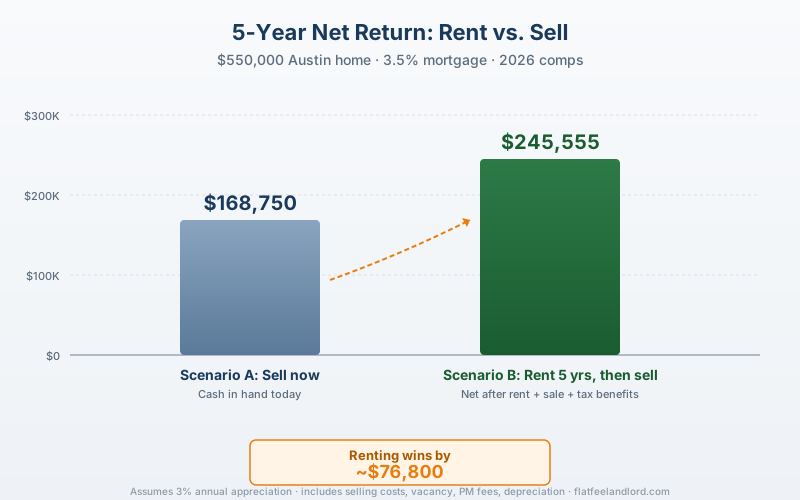
Sell now vs. rent 5 years then sell — on conservative assumptions, renting wins by ~$76,800.
This example uses conservative assumptions. Bump appreciation to 4% and the gap widens. Drop it to 2% and renting still wins by ~$40K.
The caveat: this only works if you run the operation cleanly. Extended vacancy, a bad tenant placement, or a capex surprise (roof, HVAC, major plumbing) can erase 1–2 years of gains fast. That is why hiring a property manager who places well and holds tenants long is the single biggest lever in the whole equation.
Want this math run on your actual Austin home? Send us your address and we'll send back a real 5-year rent-vs-sell projection using your mortgage rate, your submarket's real comps, and your estimated selling costs. No sales pressure — just the math. Run the numbers on my Austin home →
The Hidden Costs Most First-Time Austin Landlords Miss
When first-time landlords run their own rent-vs-sell math, they almost always overestimate cash flow because they miss these:
1. Vacancy. Most Austin rentals turn every 18–24 months. Even a fast re-lease burns 3–4 weeks of lost rent plus turn costs. Budget 4–6% of annual gross rent for vacancy in a well-managed scenario, 8–10% in a self-managed one.
2. Maintenance and capex reserve. Roofs, HVAC, water heaters, and appliances age on a schedule regardless of who's living there. The rule of thumb: reserve 1% of property value per year. On a $550K Austin home, that's $5,500/year — some years you spend $0, some years you spend $12,000.
3. Insurance rate jumps. Converting from homeowner's to landlord (DP-3 or similar) typically raises your premium 15–25%. In Texas specifically, homeowner premiums have climbed fast — 2026 landlord policies in Travis and Williamson counties run $1,800–$3,500/year on most single-family homes.
4. Property tax reassessments. Texas caps residential homestead reassessments at 10% per year. Losing your homestead exemption (because the property is no longer your primary residence) typically bumps taxes 10–25% over 1–2 years.
5. HOA fees and special assessments. If your Austin property is in an HOA, factor dues plus the occasional special assessment. Some Austin suburbs hit landlords with rental-specific registration fees or add-ons.
6. Tax prep complexity. A rental property adds Schedule E to your tax return. If you used to pay $250 for your return, plan on $400–$700 now — or $0 if your property manager files it (our Preferred plan includes annual tax filing).
7. Time. If you self-manage, expect 5–10 hours/month on an average property. Multiply that by your hourly value (your real hourly, including lost weekends) and the "savings" from DIY often disappear.
City of Austin Rental Registration: Don't Skip This
A point most national rent-vs-sell articles miss entirely: if your property is inside the Austin city limits, you have rental registration obligations.
- Repeat Offender Program / Rental Registration. The City of Austin requires rental property registration under its Building Standards ordinance. Properties within city limits must be registered, and violations of building standards can put a property in the "Repeat Offender" category.
- Short-term rental (STR) license. If you're considering renting the property as a short-term rental (less than 30 days), that is a separate license entirely with strict rules and capped availability in many ZIPs. Most accidental landlords are better off as long-term (12+ month lease) landlords.
- Suburbs are different. Cedar Park, Round Rock, Pflugerville, Leander, Georgetown, Kyle, Buda, Dripping Springs, Lakeway, and Bee Cave each have their own rules. Some require nothing. Some require annual inspections. Check with the city directly or ask your property manager.
- Disclosure requirements. Texas property code requires certain landlord disclosures — your name and address (or an agent's), security device compliance, lead paint (pre-1978 homes), and others. Missing these creates real liability.
If this feels like a lot to keep track of — that's because it is. A good property manager handles registration, renewal, and disclosure compliance as part of standard service.
Finding a Tenant Who Won't Trash Your Austin Home
The single biggest variable in whether your Austin rental succeeds or fails is who you hand the keys to. One bad placement can wipe out two years of cash flow. The screening criteria that actually matter:
- Income ratio. Gross household income of at least 3× monthly rent, documented with 30 days of pay stubs plus bank statements. Self-employed applicants: 2 years of tax returns.
- Credit. A minimum score in the 620–650 range with no recent (past 24 months) derogatory accounts. Past bankruptcy is not an automatic disqualifier if it was 4+ years ago and credit has been rebuilt.
- Rental history. At least two years of verifiable rental history with no evictions, no prior-landlord lease violations, and on-time payment confirmed by the most recent landlord (not the current one — the one before that, who has no motive to mislead).
- Employment. Stable employment with at least 6 months at current employer (for corporate transplants, verified offer letter or relocation paperwork works).
- Criminal background. Compliant with Texas and federal fair housing law — we look at relevant, recent convictions and apply an individualized assessment, not a blanket rule.
- Pets. If the property allows pets (it should — no-pet policies cut your applicant pool 40%+), separate pet screening, deposit or monthly pet rent, and breed/size policies aligned with your insurance.
The mistake most first-time Austin landlords make: they fall in love with the first qualified application and skip the second-reference call. Don't. The second landlord reference — the one before the current landlord — is where the truth usually lives.
For the full tenant screening framework, see our tenant placement process or read our deeper piece on lease agreement must-haves.
Self-Manage vs. Flat-Fee vs. 8% Property Management in Austin
Three real paths. Honest trade-offs on each.
Self-manage
- Cost: $0 in fees, but a real time commitment.
- Best for: Landlords who live in Austin, have 1 property, have prior landlord experience, and enjoy the operational side.
- Honest reality: You will be available 24/7 for maintenance emergencies. You will field 3 a.m. texts about broken A/C in August. You will do your own tenant screening (and legal liability sits with you if you get it wrong under fair housing rules). You will handle your own 5-day notice to pay-or-vacate if rent is late, your own turnover, your own tax prep. Most Austin self-managers last 18–36 months before hiring a manager.
Percentage-based property management (8–10% of rent)
- Cost on a $2,500/mo Austin rental: $200–$250/mo = $2,400–$3,000/year. Plus placement fee (50–100% of first month's rent = $1,250–$2,500), plus renewal fee ($150–$500), plus potential maintenance markups, plus eviction add-ons.
- Best for: Out-of-state landlords who want full service and don't mind the cost scaling with rent.
- Honest reality: The 8–10% model means their revenue grows with your rent increases, and they make more money when you have to place a new tenant (which happens after every vacancy). Not every percentage-based manager is misaligned — but the fee structure creates the potential for it.
Flat-fee property management (what we do)
- Cost: $139/mo on annual billing (Basic) or $179/mo on annual billing (Preferred, which includes tenant assurance, tax filing, an annual inspection, and eviction coordination). Placement fee: one month's rent + $350 listing/activation.
- Best for: Austin landlords with rents at or above $1,800/mo (which is most of the market) who want the service without the percentage penalty.
- The math: On a $2,500/mo Cedar Park rental, Preferred-plan annual cost = $2,148. A 10% manager's annual cost = $3,000. Year-over-year, you save $852 just on the management fee — and the gap widens every time your rent goes up.
For the full cost comparison including placement fees, renewal fees, and hidden add-ons, see our complete Austin property management cost breakdown.
When Renting Is the Wrong Call
We've walked through every scenario where renting wins. Honesty requires the other side, too. Sell instead of rent if:
- You need the equity within 12 months. Renting locks your capital in place.
- Your cash flow would be structurally negative and you can't absorb it. If PITI + reserves > realistic rent by more than $300/month and your personal budget is tight, renting creates stress that outweighs the appreciation bet.
- The property has deferred maintenance you can't fund. Roofs, foundations, HVAC on its last legs — these turn into $15K surprises fast. If you don't have the reserves to cover a capex hit, rent proceeds won't save you.
- You're still inside the 2-of-5 year Section 121 window and have significant gains. Taking the capital gains exclusion before it lapses can be worth more than 3–5 years of rental cash flow.
- You emotionally can't handle someone else living in the house. This is a real factor. Pushing through it creates constant anxiety.
- The property is in a declining neighborhood. If underlying fundamentals (jobs, schools, crime, infrastructure) are weakening, the appreciation bet doesn't hold. Rent math only works when the long-term value bet works.
If any of the above apply, sell. The right decision for one homeowner is not the right decision for everyone.
What to Do Next Week
If you're leaning toward renting, here's the exact sequence:
- Pull your mortgage statement. Write down rate, PITI, and remaining balance.
- Get a real rent comp for your specific address. Not a Zillow estimate — an actual comp pulled from closed leases in your 1-mile radius. Request a free rental analysis here and we'll turn it around within one business day.
- Ask your CPA about your 2-of-5 Section 121 status. This is a 15-minute conversation that can change the whole decision.
- Price out a landlord insurance policy. Call your current insurer and ask for a DP-3 (or equivalent) quote. Get the real number, not a guess.
- Decide your management path. Self-manage, flat-fee, or percentage. If you want to skip the math on option 3, see how flat-fee stacks up.
- Set your rent and list the property. Under-pricing costs you thousands over the life of the lease. Over-pricing costs you weeks of vacancy. Comps-driven pricing is non-negotiable.
If you're leaning toward selling, talk to a real estate agent who will tell you the honest days-on-market reality for your specific ZIP, not the citywide average. If you're genuinely split, the framework in this guide is how we'd help you work through it on a call. Most of the time, a 15-minute conversation makes the answer obvious. You don't owe us a decision at the end of it.
Ready to see what your Austin home would actually rent for in 2026? We'll pull real comps, tell you honestly what we think it would rent for, and give you an exact quote — no obligation, no pressure. Get your free rental analysis, explore our Austin property management services, or learn more about our flat fee model before making any decisions.
2,000+
Tenants Placed
<1%
Eviction Rate
9–12 Mo
Tenant Guarantee
4.6★
Google Rating
Our Services

Founder & CEO, Flat Fee Landlord
Mo founded Flat Fee Landlord after watching landlords overpay percentage-based managers for the same level of service. He's placed 2,000+ tenants across Texas and the DMV with a <1% eviction rate.
Frequently Asked Questions
Is it better to rent or sell my house in Austin in 2026?▾
It depends on your mortgage rate, equity position, and timeline. If you have a mortgage rate under 5%, meaningful equity, and a timeline of 3+ years before you need the capital, renting typically wins on a 5-year net basis — often by $40,000–$80,000 on a $550K Austin home. If you need equity within 12 months, your rate is 6.5%+, or your margins are thin, selling is usually the better call. Run the 6-question framework in this guide before deciding.
How much can I rent my Austin home for in 2026?▾
Rent ranges vary significantly by submarket. A typical 3-bed Cedar Park or Round Rock single-family home rents for $1,900–$2,500/mo. South Austin and East Austin run $2,200–$3,000+. West Lake Hills and Rollingwood can exceed $5,000/mo. For a real number tied to your specific address, request a free rental analysis.
What is the 2-of-5 year rule and why does it matter before renting my house?▾
IRS Section 121 lets you exclude up to $250,000 in capital gains (single) or $500,000 (married filing jointly) from taxes when you sell your primary residence — but only if you lived in the home as your primary residence for at least 2 of the last 5 years. If you rent your home out for 3+ years, you may lose this exclusion. For Austin homeowners with significant gains, this rule can swing the decision by tens of thousands of dollars. Talk to your CPA.
Does the City of Austin require rental registration?▾
Yes. Properties within Austin city limits have rental registration obligations under the city's Building Standards program. Short-term rentals (under 30 days) require a separate STR license with strict rules. Suburban cities (Cedar Park, Round Rock, Pflugerville, Leander, Kyle, Buda, Dripping Springs, Lakeway, etc.) each have their own rules — some require nothing, some require annual inspections. Your property manager should handle compliance.
What's my cash flow going to look like on an Austin rental?▾
Many Austin rentals operate near breakeven or slight negative cash flow in Year 1 when you include realistic reserves for vacancy, maintenance, and capex. The returns come from principal paydown, appreciation, and tax benefits (depreciation). A rental that breaks even on cash while you pay down $7K–$10K of principal and appreciates $15K–$20K per year is a winning rental. Don't judge rentals by cash flow alone.
Should I use a property manager or self-manage my Austin rental?▾
Self-management works for local, experienced landlords with one property and bandwidth for 24/7 availability. Out-of-state owners, career-busy owners, and anyone placing their first tenant should hire a manager. The real cost of a bad self-placed tenant (eviction, damage, vacancy) typically exceeds multiple years of management fees.
How much does property management cost in Austin?▾
Percentage-based managers charge 8–10% of monthly rent plus a placement fee equal to 50–100% of first month's rent. Flat Fee Landlord charges $139/mo on annual billing (Basic) or $179/mo (Preferred, which includes tenant assurance, tax filing, annual inspection, and eviction coordination). On a $2,500 Austin rental, flat fee saves most landlords $800–$1,500 per year versus a percentage manager.
How long will my Austin home sit vacant between tenants?▾
In a healthy Austin submarket with a well-priced, photo-ready listing, typical vacancy between tenants is 2–4 weeks. Cedar Park, Round Rock, and Leander lease fastest. Central Austin moves slightly slower due to pricing competition. Flat Fee Landlord backs our placements with a 21-day placement promise on Basic and a 9–12 month tenant assurance on Preferred and Concierge.
What are the tax benefits of converting my primary residence to a rental in Texas?▾
The main benefits are (1) depreciation — typically $10,000–$20,000/year in paper losses that offset rental income on your tax return, (2) deductibility of mortgage interest, property tax, insurance, repairs, and management fees as ordinary business expenses, and (3) a step-up in basis at the time of conversion (your cost basis for depreciation resets based on fair market value at conversion). This is tax advice territory — talk to your CPA.
Can I rent my Austin home as a short-term rental instead?▾
You can, but it's a separate regulatory path. Austin's short-term rental (STR) rules are among the stricter in Texas and licensing is capped in many ZIPs. STR income can be higher, but so are operating costs (cleaning, furnishings, higher turnover) and vacancy risk. For most accidental landlords, a 12-month lease with a screened tenant produces better risk-adjusted returns than STR.
You might also like
- How Much Does Property Management Cost in Austin, TX? A 2026 Fee GuideApril 16, 2026Most Austin property managers charge 8–10% of rent. Flat fee changes the math. Full 2026 breakdown o…
- Accidental Landlord vs. Intentional Investor: The Strategy You Both NeedApril 14, 2026You didn't plan to become a landlord, but here you are. The good news? The most successful real esta…
- Can't Sell Your Home? You're Not Alone — Smart Homeowners Are Renting InsteadApril 8, 2026The U.S. housing market has more sellers than buyers for the first time in years. Discover why homes…
Free Instant Rent Estimate
What could your property rent for?
Enter your address — see an instant comps-based rent estimate.
- ⭐ 4.6 stars · 730+ Google reviews
- ✅ 2,000+ tenants placed
- ✅ <1% eviction rate
- ✅ Tenant assurance on eligible bundles